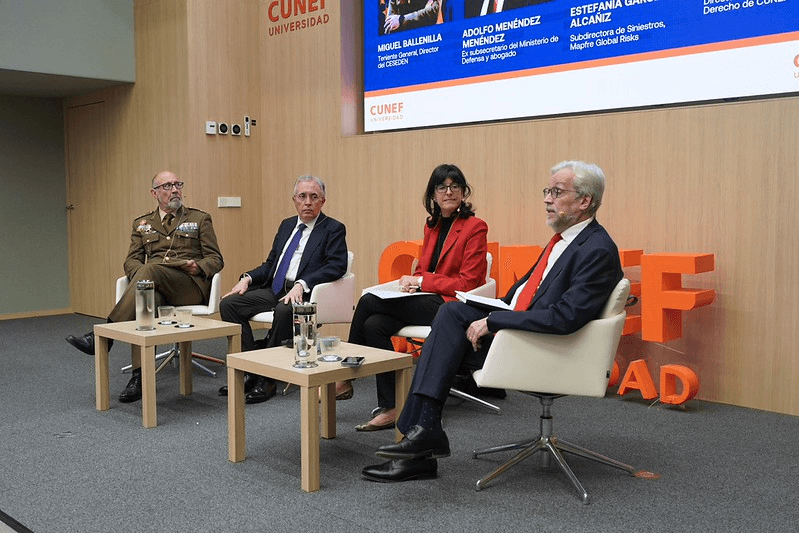


CUNEF Universidad hosts an expert panel on the impact of war and geopolitical turmoil on contracts and legal certainty
24 April 2026
The latest instalment of the cycle “Thursday Law at CUNEF Universidad”, under the theme “War and Contracting: The Impact of Conflict on Legal Certainty”, was held at the Almansa Campus Auditorium, in Madrid. The session, featuring Miguel Ballenilla, Lieutenant General and Director of CESEDEN, Adolfo Menéndez Menéndez, attorney and former Undersecretary of the Ministry of Defence, and Estefanía García Alcañiz, Deputy Director of Claims at Mapfre Global Risks, was chaired by Andrés Betancor, Director of the Department of Law at CUNEF Universidad.
The speakers discussed the nexus between war, contracts, and the new global risk paradigm, essentially concluding that geopolitical instability has become a structural factor that is redefining the rules of international trade, defence and legal certainty. Laws, contracts and insurance policies, designed for a predictable world, are facing unprecedented strain that requires a profound revision of their fundamentals.
A new world order and the quest for strategic autonomy
Lieutenant General Ballenilla opened the debate by stating that the order born after World War II “no longer works in today’s world”, highlighting that the planet’s centre of gravity has definitively shifted to the Indo-Pacific, a region that accounts for more than half of the world’s population, 60% of global growth and 65% of patents. This shift is forcing the West to adapt to a structural, rather than cyclical, change. “We are witnessing the death of an old world to give way to a new one,” he said.
In the face of this scenario, Lieutenant General Ballenilla underlined the importance of strategic autonomy for Europe, noting that “governments have failed to understand the gravity of the situation. Maintaining the status quo is tantamount to giving up. We need a different speed, a different scale and a different intensity. The solution is more Europe.”
In addition, the Director of CESEDEN warned about the “economic asymmetry of contemporary conflict”, where highly expensive defensive systems face significantly cheaper means of attack, posing a challenge that is not only military, but also budgetary, industrial and strategic.
Contract law under pressure
From the perspective of contract law, Adolfo Menéndez explained how the new geopolitical scenario has strained the balance between the binding force of contracts and the need to review them. According to the former Undersecretary of Defence, the clash between the rigidity of budgetary and contracting laws and the speed of technological innovation is especially significant in this sector, as evidenced by the lag of up to 15 years between the design and commissioning of a frigate.
Menéndez argued that the critical point is no longer the award itself, but the execution phase and the ability to adapt contracts to unforeseen circumstances. He concluded that greater flexibility and a social consensus on the importance of defence are essential, echoing the call for a more united Europe: “We need a Federal Europe in place once and for all, because without a legal framework that ensures stability, we will face serious problems. The absence of law is chaos.”
The insurance market: from anecdotal risk to central focus
For her part, Estefanía García Alcañiz shared a perspective from the insurance market, noting that the risk of war “has evolved from being anecdotal and silent to becoming a central focus”. She explained how growing tensions in critical routes like the Strait of Hormuz, a transit point for one out of five global shipments of liquefied natural gas, are forcing a complete redesign of insurance programs.
This change, explained the MAPFRE Global Risks executive, is forcing insurers to seek new formulas, such as self-insurance or the creation of ‘captives’, to manage exposures that have become very expensive in traditional markets. She insisted that the key lies in adaptability and agility to offer tailored solutions that enable commerce and logistics to continue operating, providing the necessary certainty in times of maximum uncertainty.
The session concluded with a call to action: institutions, companies and society as a whole must accept that they are living in a scenario of sustained disruption. As highlighted in the conclusions, “our laws, contracts and policies cannot continue to function as if we lived in a stable world. They must adapt without losing rigour or guarantees”.
With this seminar, CUNEF Universidad consolidates its “Thursday Law” cycle as a forum for academic and professional exchange, dedicated to analysing current legal issues using a rigorous, humanistic and forward-thinking approach. This session marked the conclusion of the series for the current academic year.
