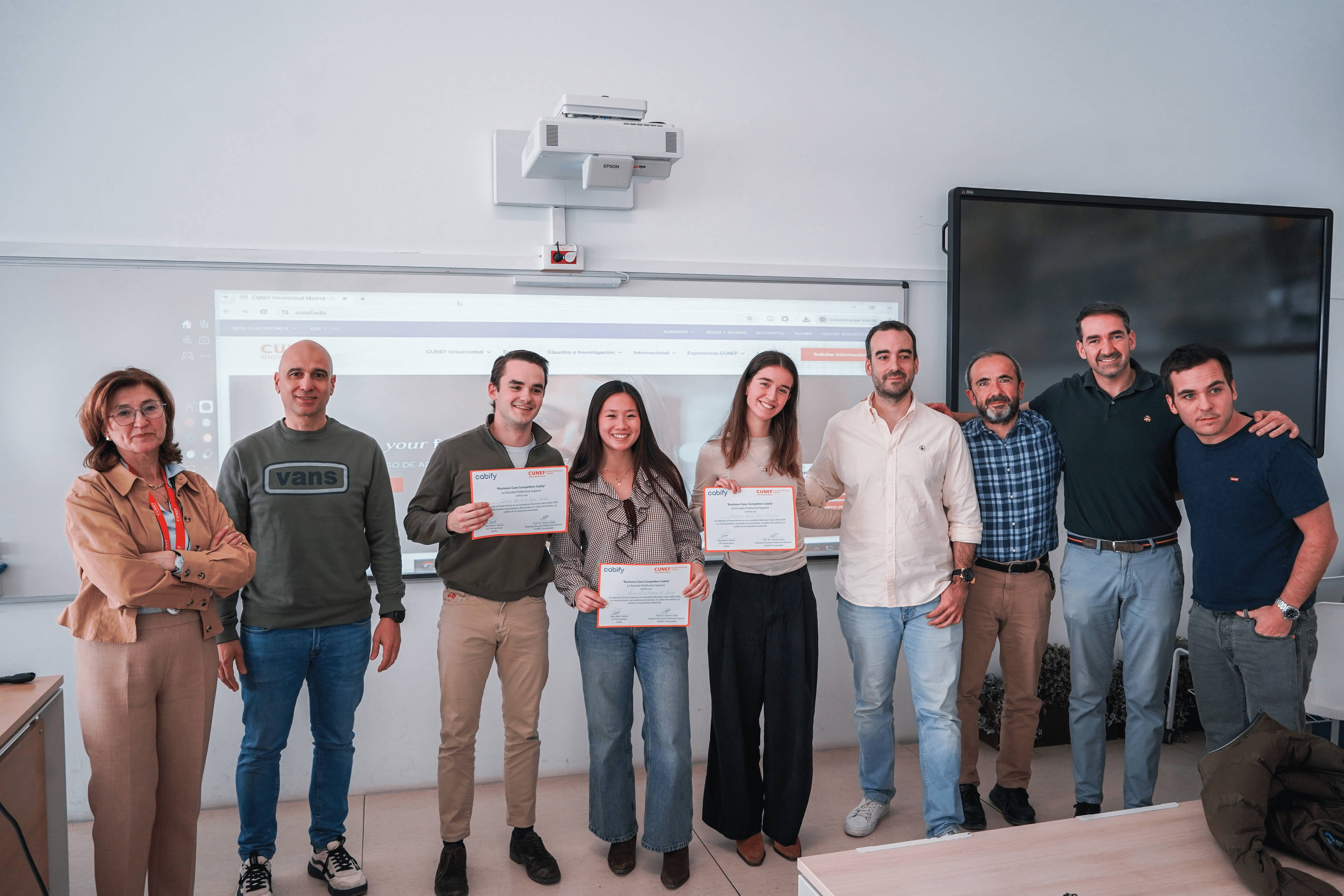


A tech strategy based on neural networks and digital twins wins the Business Case Competition by Cabify
25 February 2026
Last Wednesday, 25 February, the Pirineos Campus hosted the closing ceremony of the ‘Business Case Competition by Cabify’, an academic competition that gave students from the School of Engineering the chance to create strategic proposals for this Spanish mobility company. The challenge proposed by Cabify was structured around the future of cities and the foreseeable impact of autonomous transport technology. CUNEF Universidad students worked in teams to design strategies focusing on the business itself, value generation and the role of future regulations in the mobility ecosystem.
The panel of the ‘Business Case Competition by Cabify’ praised the high quality of the proposals and granted the first prize to the project presented by Íñigo Sola, María Orozco and Cayetana Faura, students of the Double Bachelor in Business Administration and Data Science. Their technology strategy involves using neural networks, designing intelligent vehicle routes and developing digital twins to create hybrid fleets of human-driven and automated vehicles.
The second prize went to “Teclesmayer”, a team made up of Carlos Rodríguez Brito, Candela San Román, Gonzalo Teclesmayer and José María Capapé, while the third prize was awarded to “Stratechy”, the project created by Alberto Cano Moreno, Pablo Ceballos Arenas, Iván Mier Vaquero and Laura Siso Rodríguez. Finally, the panel awarded an honourable mention to “Nuakchott”, with Juan Figueroa Losana, Lucas Pazos González, Pablo Montesdeoca Simón and Álvaro Domingo García.
The Business Case Competition is an academic competition organised by CUNEF Universidad to enable students to come closer to business reality and use the knowledge gained in class to solve real-life problems. It encourages students to develop skills including strategic proposal analysis and development, the dispersed data management, teamwork, and synthesis and presentation skills, among others. In every one of its 17 editions, the Business Case Competition has been organised in collaboration with leading national and international companies.
